Female Mobility and Gendered Space in Ancient Greek Myth by Ariadne Konstantinou
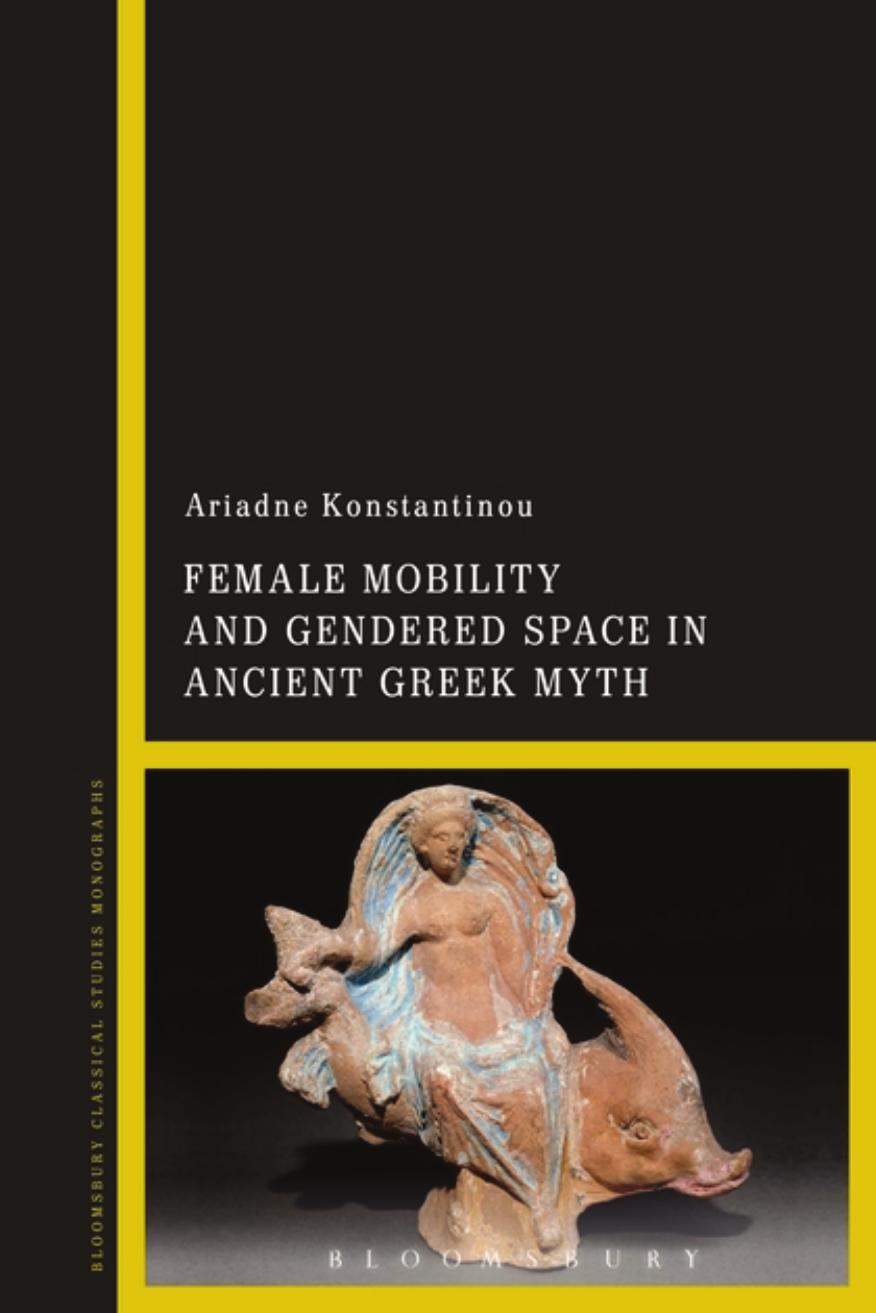
Author:Ariadne Konstantinou [Konstantinou, Ariadne]
Language: eng
Format: epub, pdf
Tags: history, Ancient, Greece, Social Science, Folklore & Mythology, Gender Studies, Literary Collections, Ancient & Classical, Religion, Women's Studies
ISBN: 9781474256773
Google: 7-JDDwAAQBAJ
Publisher: Bloomsbury Publishing
Published: 2018-01-25T23:52:24.297746+00:00
4
Female mobility and gendered spaces between myth and ritual
Participation in rituals is often thought to have provided one of the opportunities for Greek women to leave their household. Indeed, several studies have shown that women must have enjoyed a greater freedom within religious contexts.1 Chapter 4 examines the mobility of two groups of mythical heroines whose stories are regularly related to ritual contexts. It is in these stories that the boundaries between myth, social ideology and actual practice seem to become especially blurred. The first section looks on the mobility of maenads during the mountain rituals in honour of the god Dionysus, by examining the creation of ritual space in Euripidesâ Bacchae. This is followed by a discussion of the space that young huntresses are imagined to occupy while hunting out in the wilds. The discussion also addresses whether the myths of Callisto and Iphigenia should be connected to the site of Brauron, on the eastern coast of Attica, where the ritual of the arkteia took place. The chapter thus aims to contribute to our understanding of female mobility in ritual contexts and its representation in myth. This is an important topic for ancient Greek cultural history, both from the perspective of religion and concerning our understanding of womenâs experience and agency.
Geographically speaking, the chapter is rather Athenocentric, in the sense that Euripides is an Athenian probably writing for a mainly Athenian audience, though of course the action of the Bacchae takes place in Thebes.2 In relation to huntress myths and their possible connection to Brauron, we know that this site formed part of Athenian public religion, since the Athenian Acropolis also housed a sanctuary dedicated to Artemis Brauronia (Rhodes and Robbins 1979). In matters of chronological boundaries, the space of the maenads is based on fifth-century BCE sources â Euripidesâ Bacchae is often dated to around 405 BCE. In the case of huntress myths, however, the chronological boundaries are stretched a bit, since few sources seem to have been preserved from the earlier periods. The chronological considerations are further developed at the opening of the section on huntresses. Lastly, this chapter marks a shift from female mobility to (gendered) spaces, due, primarily, to the focus and perspective of the primary sources. This shift offers an opportunity to investigate both mobility and space, both dynamic and static elements. This combination will lead me to discuss in Chapter 5 what sort of spaces mobile women do not inhabit in Greek mythic imagination and the âglass wallsâ they apparently never shattered. Proscriptions on mobility seem to pervade mythic thought as well.
We are now much better informed about the habits of Greek women in tasks related to religious activities outside the household. For example, in Athens, women were often the ones who tended the graves of the dead. They also had important roles as priestesses, a task which provided them the opportunity to be outside the house and to serve in public (Connelly 2007). Indeed, the new consensus view is that, in ritual contexts, women had plenty of opportunities to go out of their household.
Download
Female Mobility and Gendered Space in Ancient Greek Myth by Ariadne Konstantinou.pdf
This site does not store any files on its server. We only index and link to content provided by other sites. Please contact the content providers to delete copyright contents if any and email us, we'll remove relevant links or contents immediately.
| Anthropology | Archaeology |
| Philosophy | Politics & Government |
| Social Sciences | Sociology |
| Women's Studies |
Born to Run: by Christopher McDougall(7132)
The Leavers by Lisa Ko(6950)
iGen by Jean M. Twenge(5419)
Sapiens by Yuval Noah Harari(5374)
Spare by Prince Harry The Duke of Sussex(5202)
The Kite Runner by Khaled Hosseini(5185)
Machine Learning at Scale with H2O by Gregory Keys | David Whiting(4317)
Bullshit Jobs by David Graeber(4195)
Never by Ken Follett(3961)
Goodbye Paradise(3812)
Livewired by David Eagleman(3776)
Fairy Tale by Stephen King(3401)
A Dictionary of Sociology by Unknown(3086)
Harry Potter 4 - Harry Potter and The Goblet of Fire by J.K.Rowling(3076)
The Social Psychology of Inequality by Unknown(3038)
Will by Will Smith(2929)
The Club by A.L. Brooks(2927)
0041152001443424520 .pdf by Unknown(2849)
People of the Earth: An Introduction to World Prehistory by Dr. Brian Fagan & Nadia Durrani(2739)
